
Mice-Turkeys-Quails-Wolves-Humans
I grew up in the city of Vienna; the nearest tree was several blocks away. My earliest recollections of animals relate to chickens at my paternal grandmother's house in the country. The hen house had two fenced-in runs, but only one run was used by chickens; the other one became my playpen with a sand box. This gave me an early opportunity to watch the hens and the rooster, to talk to them, and to befriend them. There were also two dogs, a little gray schnauzer and a German shepherd, a canary, and many wild birds and other animals in the big garden--fireflies, beautiful butterflies, big staghorn beetles, ants, and earthworms. Summer vacation with my maternal grandparents gave me early insight into peasant life with cows and horses and in the little run in the back yard, and in ponds and a trout stream I discovered aquatic life.
The first animal I raised successfully was a kestrel, during my first year at the university in 1946. Since meat was scarce during the lean postwar years, I had to catch his food myself and soon became an experienced mouser, even invented a better mouse trap (51). Without a refrigerator for storage, I kept my mice alive up to the moment of their demise, and soon found them more interesting than the kestrel. I discovered their high-pitched vocalizations, which were inaudible to most people, and my subsequent research in sound perception became the core of my dissertation and the basis for my further research into bioacoustics (48, 52). During my dissertation research, I stumbled on many different aspects of rodent behavior. In the context of an analysis of the behavior of newborn mice, my friend Heinz Prechtl joined me in a comparative study of mammalian neonates, involving observing and experimenting with puppy dogs, kittens, and human babies (50).
When I became assistant to Konrad Lorenz in 1951, my first project was to repeat and reevaluate the controversial experiment about the effect of predator models on ducks, geese, and gallinaceous birds performed by Lorenz and Niko Tinbergen. They had performed this experiment together in 1937 but later differed in interpretation of the results.

The "Hawk-Goose-Model", used by Lorenz and Tinbergen.
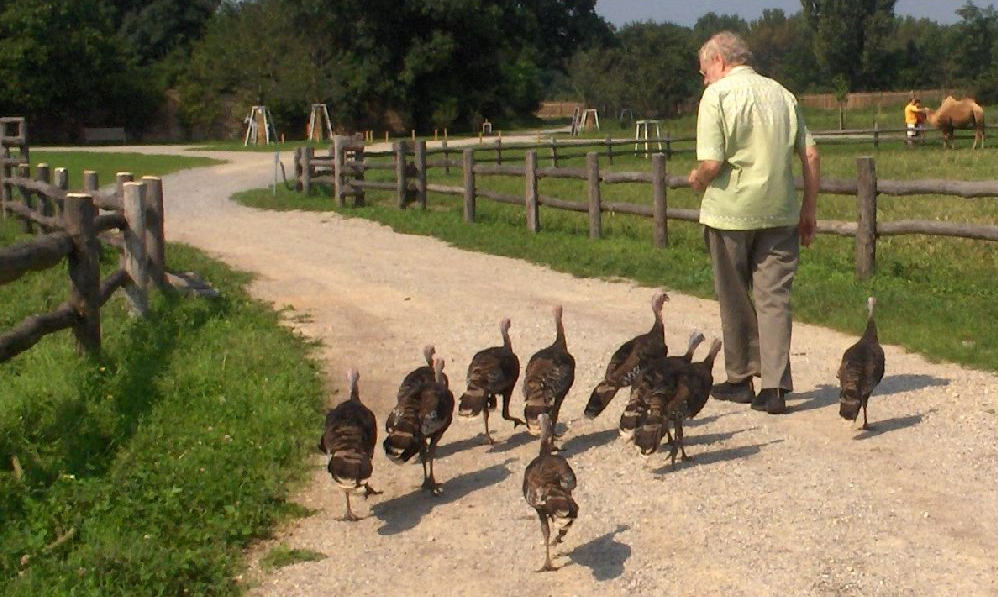
Since, according to Lorenz, the famed differential response to the "Hawk-Goose Model" was shown only in young turkeys, I tried to conduct my experiments under as close to the original conditions as possible, but--due to various mishaps--did not succeed until 1961 (58, 60, 61a, b, ). By that time I had become enough of an expert on turkey behavior to get first an invitation for one year and ultimately a job for 20 more years in the USA (64b, c, 65, 69, 70a, b, c).
As, over the years, support for behavioral research and for turkey studies was cut back, I scaled my animal subjects down in size, working with pheasants, chickens, and quail, and finally with the smallest of all galliformes, the blue-breasted quail (72, 73, 74, 76, 78, 82, 83, 84).
Eventually, I felt sufficiently secure in the methods I had tested on animals to apply them to the study of human behavior (85, 88b, 92, 94, 95, 98a, b, 01c) and I began to propose less anthropomorphic, i.e., less self-centered views of human ethics (98b, 00).
